The Story
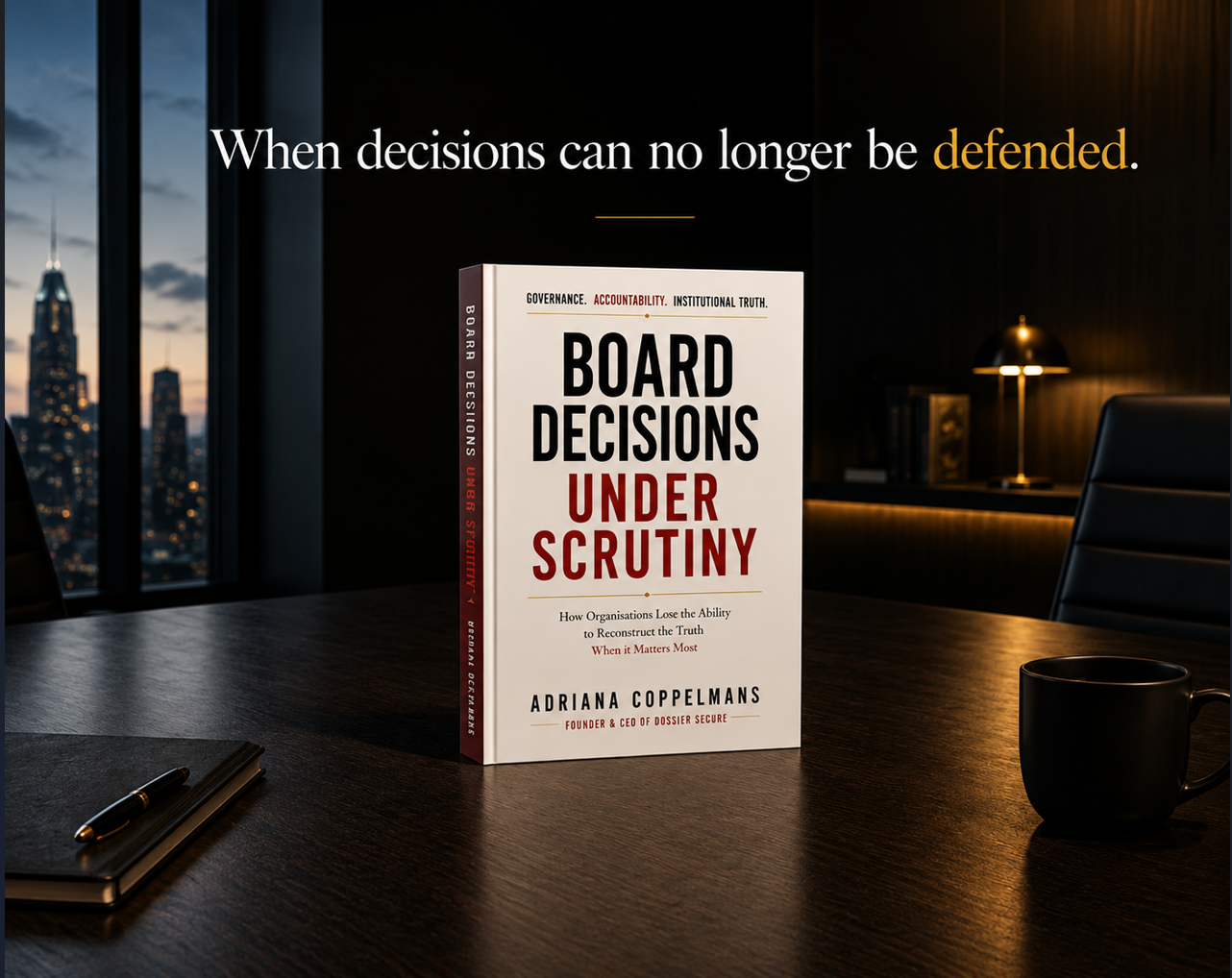
When decisions can no longer be defended, the question shifts from "Did you have a policy?" to "Can you prove what your organisation actually did?"
Board Decisions Under Scrutiny examines how institutional memory fails. It traces the records that should have captured how judgment arrived at decisions — and discovers instead the gaps that leave organisations exposed.
On Institutional Memory
Organisations preserve records and policies. But they rarely preserve evidence of how decisions actually moved through discussion, objection, and approval.
On Defensibility
A defensible decision is one you can still explain after the outcome is known. It requires evidence of what was decided, who decided, what they knew, and why they acted.
On Governance Under Pressure
When regulators demand proof, organisations discover the difference between a record that describes a decision and a trail that explains how judgment arrived there.
The Dossier Secure Connection
The book's core insight became Dossier Secure's foundation: organisations that can reconstruct what actually happened are defensible. Those that cannot are exposed.
For organisations under DORA and NIS2
The epilogue of this book names three conditions for reconstruction. Provenance, meaning every decision traceable to the evidence, context and authority that existed at the time. Replayability, meaning the environment as it stood at the moment of decision can be recreated. And interpretive continuity, meaning one shared understanding of what the evidence means.
Dossier Secure Enterprise is built for the first two.
Every obligation points to the verbatim legal text, with article, fingerprint and source. A decision is executed again against the policy and authority that applied at the time, byte for byte, and stops the moment a version no longer matches. History cannot be altered, so what was recorded cannot quietly disappear. There is no AI in the derivation, the weighting or the output, because an outcome that cannot be reproduced proves nothing afterwards.
The third condition, shared understanding inside the organisation, is not something any system solves for you. That remains human work.
Enterprise offers no protection and no guarantee of compliance. It offers the ability to demonstrate afterwards how a decision was actually reached.
About the Author
Adriana Coppelmans spent 30 years in governance, audit, and institutional accountability in the Netherlands. She witnessed how organisations under pressure discover that their records describe outcomes but not how judgments arrived there.
This study in narrative form is drawn from documented patterns of institutional failure. It traces a fictional board through real governance problems and shows what evidence-grade reconstruction requires.